
AP Exam Success Strategies: How To Navigate 2026 Digital/Hybrid Testing
Every year, AP exams loom on the calendar for May. Busy students who are trying to survive a packed semester think to themselves, I still have time, I’ll start reviewing material closer to the date. Then boom, test day arrives and students are scrambling to remember what they learned all the way back in September.
But AP exams do not have to be a dreaded hurdle to finishing the school year. With the right prep timeline, these tests are actually an opportunity for students to claim some early wins before they ever set foot on a college campus. At Breakaway Prep, we believe the goal is to work smarter, not harder. Success is not about last-minute cramming; it is about refining your approach to these exams and understanding the specific, often overlooked rules of the game.
The 2026 Digital/Hybrid Testing Model for AP Exams
Most students know that digital testing has been the official standard since 2025 for most AP exams. But there is a detail many miss: not every AP exam has completely transitioned to Bluebook. While subjects like English and History are now fully digital, many math and science exams are hybrid. To find out if a specific test is fully digital, hybrid digital, or not delivered through Bluebook at all, check out this 2026 overview.
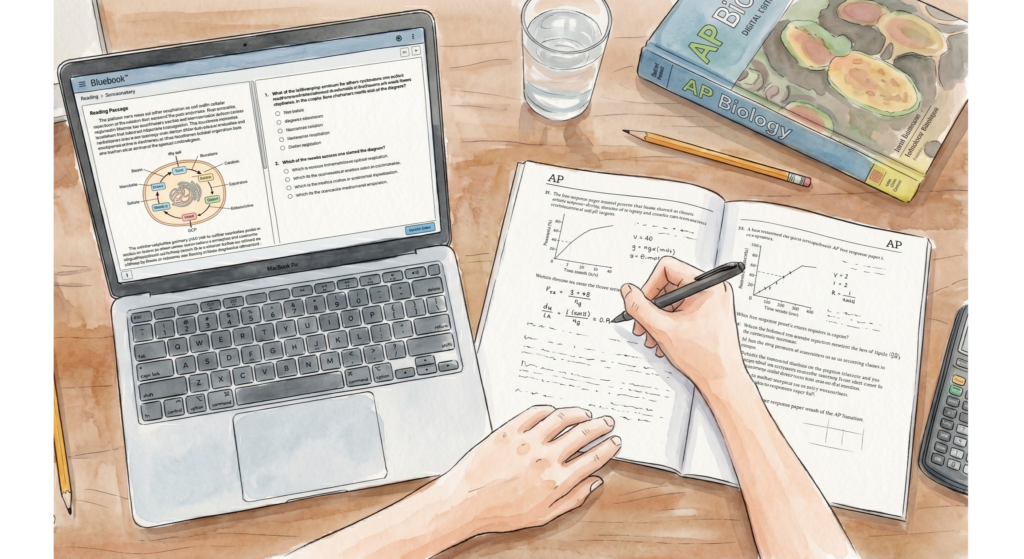
In a hybrid exam, students view the questions on their screen in the Bluebook app but write their actual work and free-response answers in a physical paper booklet. This “split-attention” task (looking up at a screen and down at a page) is a specific skill, and this format changes how you pace yourself and how you organize your scratch work. Getting used to this back-and-forth before test day can significantly lower a student’s stress, so we highly recommend downloading Bluebook and familiarizing yourself with the app.
For students taking hybrid exams, College Board has sample free-response booklets you can download to familiarize yourself with the different formats before test day.
The Important Benefits of College Placement vs. Credit
When we talk about AP scores, the conversation usually focuses on earning college credit to save on tuition. That is a massive perk, but for many students, the real value is advanced placement.
Beyond the potential financial savings, strong AP scores signal to admissions officers that a student can thrive in demanding academic environments. Some universities may not let you graduate early, but they will let you use a high AP score to skip introductory “weed-out” classes. This allows a freshman to jump straight into smaller, more interesting upper-level seminars. It is about giving yourself more freedom in your schedule to pursue a double major or a study abroad program that might otherwise be impossible.
Since every university handles these scores differently, it is worth checking how your top-choice schools will reward your hard work. You can use the AP Credit Policy Search tool to see exactly which scores can earn you credit or advanced placement at specific colleges. Knowing these policies early can help you decide which exams to prioritize in the spring.
Don’t Fear Your Score Report
A common concern for students is that a low AP score will haunt their college applications. Here is a secret: you have more control than you think.
- Score Choice: You can choose which scores to send to colleges. If a test does not go your way, you do not have to report it. Just remember that the AP Program must receive your request to withhold a score by June 15th of the year you took the test.
- Self-Reporting: Many colleges now allow you to self-report your scores on your application, meaning you only need to pay to send the official report once you have actually been accepted.
- A “3” is Not A Failure: While a 4 or 5 is the goal, many state university systems are now required to accept a score of 3 for credit. Always check the specific policy of your target schools before you decide a score is not “good enough” to send.
AP Study Strategies That Work

Real success rarely comes from last-minute cramming; it comes from having a longer runway to prepare and improve. Most students studying for AP exams do not need more generic classwork, they need targeted guidance to close specific gaps. Here are three broader study tips we recommend:
- Focus on the Rubrics: Knowing exactly how a grader awards points on a free-response question is often just as important as memorizing dates or formulas.
- Master the Digital Tools: The Bluebook app has a built-in graphing calculator and annotation features. If you are not practicing with those specific tools now, you are losing time on test day.
- Triage Your Time: Different sections of an AP exam are not always equally weighted (the AP English exam is one example). Make sure you spend your energy on what will carry the most weight in the final score.
It can be a lot for a student to learn these strategies on their own while also keeping up with their daily coursework. Our AP Intensive tutors are here to help students identify exactly where to focus so they can feel more in control and less overwhelmed as AP exams near.
Test Day Checklist
On the morning of an exam, you don’t want any surprises. Here is how to keep things low-stress:
- Bluebook Check: If you are taking a digital exam, make sure your device is fully charged and that it passes the “Test Your Device” check in Bluebook.
- Non-Digital Essentials: Even for digital tests, you still need a few physical items. Bring two sharpened No. 2 pencils (with good erasers) and two pens with black or dark blue ink for the free-response sections.
- Calculator Rule: Check the official AP calculator policy for your specific subject. Bring a compatible graphing calculator, and don’t forget backup batteries or a charging cable.
- Dress in Layers: Testing rooms are notoriously unpredictable! They are often either a sauna or a walk-in freezer. A hoodie is your best friend.
- Leave the Tech in Your Bag: Your phone, smart watch, and even fitness trackers must be completely powered off and stored away. A simple, non-digital wristwatch is the best way to keep time without breaking any rules.
A Quick Note on Accommodations
If your student is eligible to receive accommodations like extended time or a small group setting, these must be officially approved by the College Board. We recommend reaching out to your school’s SSD coordinator to verify that your approvals are active for the upcoming spring window. If a student has a sudden “temporary impairment” such as a broken arm or a concussion, your school coordinator can still request temporary supports as late as 14 days before the exam. If you find yourself in this situation, reach out to your school’s SSD office immediately to ensure those supports are in place for test day.
Our AP Intensive Program
If all of this feels overwhelming, please know that you are not alone. Breakaway has been helping students navigate the stress of AP exams for over 20 years, and we have seen first-hand how much a little bit of targeted support can change a student’s entire outlook. Most students don’t need more busy work; they just need an encouraging partner to help them find their footing.
Breakaway’s AP Intensive is designed to provide that steady hand. It is a targeted tutoring package of six one-hour sessions designed to deliver high-impact instruction when it matters most. Whether your student is tackling AP Bio, Chem, Physics, Calculus, History, or English, we match them with a tutor who knows that specific test inside and out. Students receive a customized plan that builds on their strengths and targets knowledge gaps.
AP Intensive may sound, well, intense, but it’s really a low-stress way to make sure all the hard work you put in since September pays off in the spring. We urge you to register early to get your preferred tutoring dates and times as exams get closer.
Ready to get started? Learn more and register for the AP Intensive here.