


If you’re trying to decide between the ACT vs SAT, you’re not alone. One of the most common questions parents ask is: “Which test is better?”
On the East Coast, the SAT often feels like the default. It’s the brand name most parents know, and it’s what many of us grew up taking. Because of this, many families sign their students up for the SAT without ever considering the alternative.
However, the testing landscape has evolved significantly. The ACT is not just a “backup” test option; for many students, it is the strategic choice that leads to a higher score.
After analyzing these exams for more than 20 years, our team has found that the right answer almost always comes down to which one fits your student’s personal testing style. So, what are the key differences between the modern SAT and ACT, and how should you determine which one fits your student best?
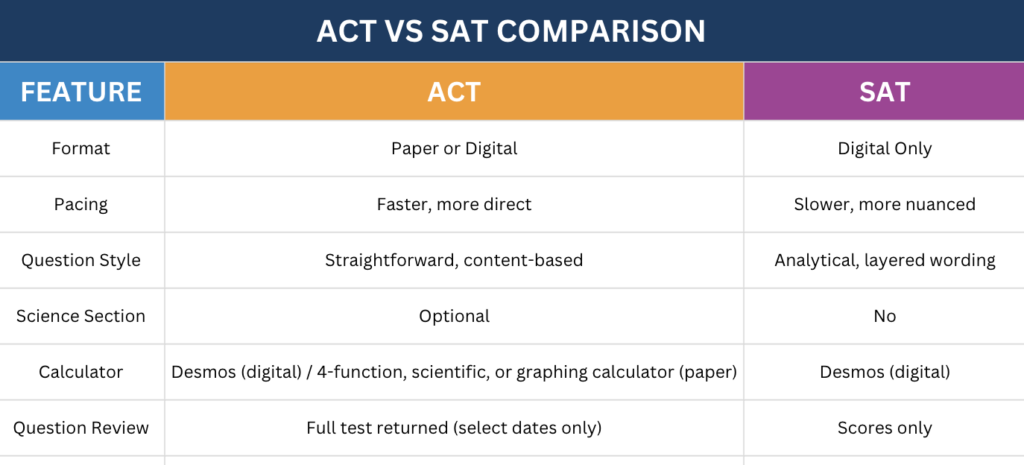
ACT vs SAT: Quick Comparison
The SAT: What Parents Should Know
The College Board has fully transitioned to the Digital SAT. This new test is shorter and adaptive, meaning question difficulty adjusts based on performance. However, because this format is relatively new, it comes with a few unique characteristics that can be challenging:
- Practice Test Material Availability: After the transition to the digital format, the pool of practice tests available for the SAT is significantly smaller. The College Board provides a limited set of official tests via their Bluebook app, but compared to the decades of paper tests that were previously available for test prep, the resource pool for practice is now tighter. This is important because practice tests are a critical tool to help students identify patterns, understand pacing, and correct recurring mistakes. Access to authentic material directly impacts how efficiently a student can improve and how test preparation must be structured.
- Score Feedback: When students receive their Digital SAT scores, they get a big-picture view of their performance when they receive their section scores. But unlike in the past, students no longer receive copies of the specific questions they missed. This makes the test efficient to grade, but makes it difficult to review the test for improvement.
For some students, the adaptive format and shorter section structure of the SAT is appealing. For others, the nuanced wording and layered logic can feel more challenging. It often comes down to if the way the SAT tests a student’s ability to navigate nuanced phrasing and critical thinking puzzles feels intuitive for an individual student or not.
The ACT: What Parents Should Know
In September 2025, the ACT introduced a streamlined exam with a new digital option featuring fewer questions, increased time per item, and a Science section that is no longer mandatory. The ACT has:
- Transparency in Scoring: One of the ACT’s biggest strengths is its transparency. If a student takes the ACT in April, June, or October, they can receive a copy of the actual test questions along with their answers. This is incredibly valuable for tutoring; we can look at a missed question and immediately determine if the error was due to a lack of knowledge or simple timing pressure.
- A Vast Library of Resources: Because the ACT can be taken on paper or digitally and, more importantly, because the format has been stable for so long, there is an extensive library of previously administered exams available for practice (literally hundreds of real, previously administered tests). This ensures that students never run out of authentic material to hone their skills.
The ACT is widely considered a “content-based” exam. It tends to be more straightforward than the SAT. If a student misses a question on the ACT, it is usually because they didn’t know the concept or ran out of time, not because they misinterpreted the question’s intent.
Leveling the Playing Field: Desmos and Science
Two major recent changes have made the decision between the two tests even more interesting:
- The Desmos Calculator: Both the Digital SAT and the Digital ACT now allow students to use the Desmos graphing calculator. This is a game-changer for students who are visual learners in math, and we teach students how to leverage this tool on both exams.
- Optional Science: The ACT Science section is now optional. If your student opts out of Science, the ACT is now roughly the same length as the SAT. Note: A small number of schools, such as the Naval Academy or Georgetown, may still require the Science section, but for most colleges and universities it is not mandatory.
So, Which Test Should My Student Take?
The simple answer is that neither test is objectively easier. The most important takeaway for parents is this: colleges view the SAT and ACT as equals. A top score on one is just as valuable as a top score on the other.
Therefore, the goal is to find the test that showcases your student’s strengths. We strongly recommend against guessing which test will allow your student to perform better. Instead:
- Take a Diagnostic: Have your student take a baseline full length practice test for both the SAT and the ACT.
- Compare the Data: Analyze the scores to see which test they scored more highly in, but also consider which style feels more natural. Some students prefer the slower pace but deeper thinking of the SAT; others thrive on the faster, straightforward pace of the ACT.
- Pick One and Focus: Once you know which test is the better fit, focus all preparation efforts on that single exam. For most families, the right choice becomes obvious once both tests are experienced under realistic conditions.
Ideally, When Should We Start Test Prep?
Timing is everything when it comes to test prep. For most students, the ideal timeline looks like this:
- Sophomore Spring: Take your diagnostics and decide on SAT vs. ACT.
- Summer/Early Fall: Begin preparation. This often includes weekly proctored practice tests (usually on Sundays) to build the “testing stamina” that homework alone cannot teach.
- Junior Year: Aim to take the official test 2 or 3 times, finishing the testing process by the fall of Junior year.

Unsure which test is right for your student? At Breakaway Prep, we remove the guesswork. Students can take one SAT and one ACT through our free Sunday practice tests. These are full-length, proctored exams administered under real testing conditions (Zoom options available upon request).
Once your student has experienced both exams, you’ll receive the results within a week and can then choose to schedule a complimentary consultation with an expert to review the scores and determine the smartest path forward for your student.
Breakaway Prep has helped thousands of students in New Jersey and beyond prepare for the ACT and SAT over the past two decades. Learn more about our tutoring and college counseling services.